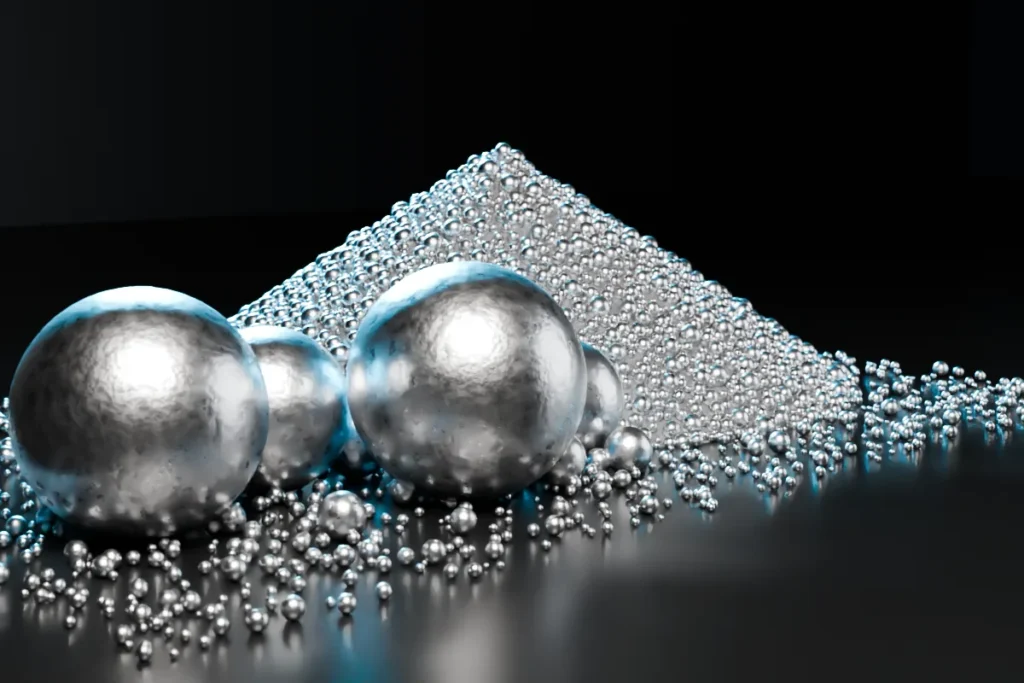
In short: 316L is a low-carbon, molybdenum-bearing austenitic stainless steel and one of the most widely used steel powders in metal 3D printing. Its corrosion resistance, high elongation and easy processing make it a standard choice for fluid-handling, food, chemical and medical prototype parts.
Typical applications
- Pump, valve and manifold bodies
- Food and pharmaceutical equipment parts
- Marine and chemical plant components
- Heat exchangers and parts with internal channels
- Fixtures, jigs and prototypes
Reference properties of printed parts
| Tensile strength (MPa) | 710 ±50 |
|---|---|
| Hardness | 227 ±10 HV30 |
| Thermal conductivity (W/m·K) | 15 (20 °C) |
| Elongation (%) | 41 ±5 |
| Yield strength (MPa) | 590 ±50 |
Solid-part reference values from the cited datasheet; not a powder or batch guarantee. Source: 3D Systems · LaserForm 316L(B), p.1 ↗
Powder properties
| Particle size cut | 15–53 µm |
|---|---|
| Flow time | ≤ 20 s/50 g |
| Apparent density | ≥ 3.5 g/cm³ |
| Tap density | ≥ 4.0 g/cm³ |
Source: CNPC POWDER Company Catalog. Catalog data is a reference for material selection; the datasheet, certificate of analysis and application tests of the delivered batch prevail.
Particle size and compatible processes
The standard cut is 15–53 µm, suitable for laser powder bed fusion (LPBF / SLM / DMLS) machines. Coarser cuts for DED/LMD processes can be requested. Share your machine model and layer thickness and we will confirm the right cut and batch documents together.
Frequently asked questions
Which 3D printers can process 316L powder?
316L is widely used on laser powder bed fusion (LPBF) machines such as EOS, Nikon SLM Solutions, Renishaw, Farsoon, BLT and Eplus3D. The machine-specific parameter set and particle size cut are confirmed at the quotation stage.
What is the difference between 316L and 304L powder?
316L contains 2–3 % molybdenum and therefore resists pitting corrosion in chloride environments better than 304L. For seawater, chemicals or disinfectants 316L is usually preferred.
316L powder price: what does it depend on?
The price depends on order quantity (kg), particle size cut, packaging (argon-filled cans or bottles), required documents (certificate of analysis, PSD report) and lead time. For a current price, state the quantity and your machine model in the quote form.
Which documents come with the order?
A certificate of analysis with chemical composition, particle size distribution (D10/D50/D90), flow and density values can be requested for each batch. Additional documents for aerospace, medical or dental projects are confirmed at the quotation stage.
Price and supply
Send your price and delivery request for 316L powder with quantity, particle size, machine model and required quality documents. Supply options and documents are confirmed with the quotation.
Chloride level, temperature, surface finish and corrosion testing matter — the alloy name alone is not enough.
 VMP
VMP POWDMAX
 CNPC POWDER