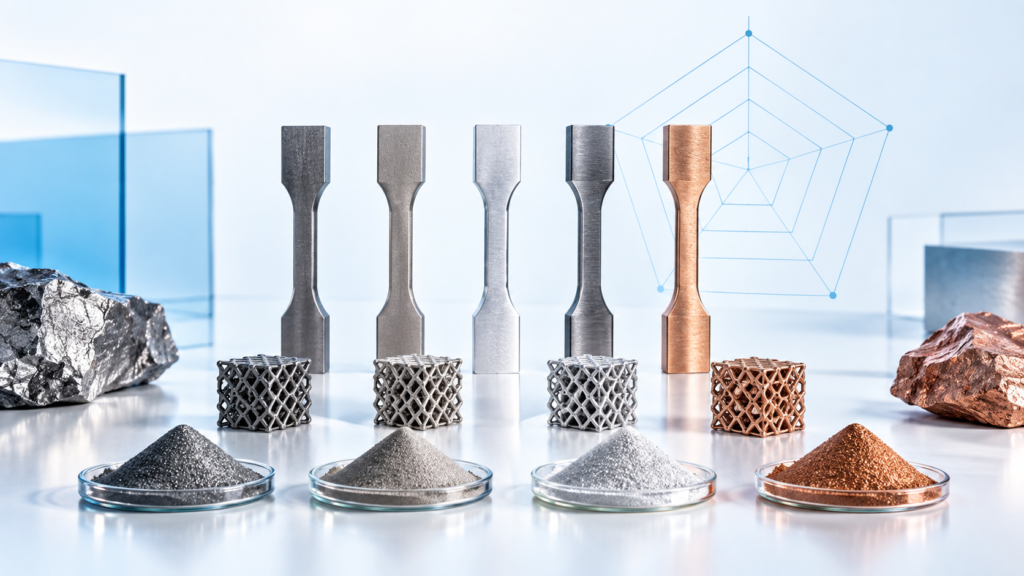
Choosing a metal powder takes more than matching an alloy name. Tensile strength, hardness and ductility vary with production method, build orientation and heat treatment. PRODA METAL’s sourced comparison of 22 materials makes these differences visible and supports your initial assessment.
Explore the full 22-material comparison ↗
Download the source workbook (Excel, Turkish) ↗
Which materials are included?
The comparison covers 316L and 304L stainless steels; 17-4PH, 18Ni300, Corrax, 420 and H13 steels; Inconel 718, Inconel 625 and Hastelloy X nickel alloys; Ti6Al4V (Titanium Grade 5), TA15 and TA1 titanium materials; AlSi10Mg, AlSi7Mg and Scalmalloy aluminium alloys; pure copper, CuSn10, CuCrZr, CuCr, pure silver and 925 silver references.
What do the five properties mean?
- Tensile strength (MPa): The highest engineering stress reached during a tensile test. It does not, by itself, describe fatigue life or high-temperature performance.
- Yield strength (MPa): A strength measure used to define the onset of permanent deformation. Read it together with the source’s test method and any specified offset.
- Hardness: Resistance to local indentation. HV, HB/HBW, HRC and HRB are different test scales: for example, 50 HRC and 170 HV cannot be ranked by their numerical magnitudes alone.
- Elongation (%): The tensile specimen’s extension after fracture. It helps assess ductility, but specimen geometry and gauge length matter.
- Thermal conductivity (W/m·K): A material’s ability to conduct heat. Comparisons without temperature information can mislead; electrical conductivity is a different quantity.
Why does the same alloy name not guarantee the same performance?
Our table includes both additive manufacturing (AM) specimens and conventionally produced materials. Do not treat an annealed plate as a direct equivalent of an aged 3D-printed specimen. Production method, XY/horizontal or Z/vertical orientation, post-processing and test conditions can change the result.
An example of how to read the table
For XY-oriented, as-built specimens, the 3D Systems LaserForm 316L(B) datasheet reports tensile strength of 710 ±50 MPa, yield strength of 590 ±50 MPa and elongation of 41 ±5%. In this datasheet, ± represents two standard deviations. The 15 W/m·K conductivity value at 20 °C in the same row is a literature reference quoted by the datasheet, not a result measured on that printed specimen. Even numbers within one row therefore need their source notes. Source: 3D Systems LaserForm 316L(B), p.1.
How can you compare materials for your application?
- Define the requirements: Document loading, operating temperature, corrosion environment, weight, heat-transfer needs and expected part life.
- Match the manufacturing condition: Identify the machine, process, build orientation and intended heat treatment.
- Narrow down the candidates: Consider ductility, machinability and other application requirements alongside the priority property. The highest individual number is not the best choice for every application.
- Separate powder data from part data: Particle size distribution, chemistry, flow and morphology describe powder supply characteristics; the mechanical values in this table are solid-material or part references.
- Request verification: Complete selection with the current technical datasheet, batch CoA, SDS and specimen tests appropriate to your application.
Missing values and radar charts
A dash (—) means that no matching verified value was found in this research; it does not mean zero. Do not treat ≥ or ≤ limits as averages. Product-card radar charts map physical values to fixed references on 0–5 axes; they are not quality ratings. Hardness scales are not automatically converted, only conductivity values at 20–25 °C enter the radar calculation, and missing axes are not assigned estimated scores.
Comparison table: 22 metal materials
The values describe the solid material or part specified in the source. Production and heat-treatment conditions differ; read the row-specific notes. On smaller screens, scroll horizontally to see all columns.
| Material | Production / heat treatment | Tensile strength (MPa) | Hardness | Thermal conductivity (W/m·K) | Elongation (%) | Yield strength (MPa) | Source |
|---|---|---|---|---|---|---|---|
| 316L — Stainless steel | AM · XY · as-built | 710 ±50 | 227 ±10 HV30 | 15 (20 °C) | 41 ±5 | 590 ±50 | [1] |
| 304L — Stainless steel | Conventional · annealed plate/sheet | ≥485 | ≤201 HB | 16.3 (100 °C) | ≥40 | ≥170 | [2] |
| 17-4PH — Precipitation-hardening stainless steel | AM · XY · vacuum H900 | 1335.8 ±5.2 | 42.1 ±0.5 HRC | — | 14.0 ±0.8 | 1235.2 ±9.8 | [3] |
| 18Ni300 — Maraging steel | AM · XY · solution-treated and aged | 2085 | 54 HRC | — | 4.5 | 2020 | [4] |
| Corrax — Stainless mould steel | Conventional · aged to approximately 46 HRC | 1500 | ≈46 HRC | 18 (200 °C) | 11 | 1400 | [5] |
| 420 — Martensitic stainless steel | Conventional · hardened bar | 1793 | 51 HRC | 24.95 (100 °C) | — | 1269 | [6] |
| H13 — Hot-work tool steel | AM · horizontal · stress-relieved at 650 °C for 2 h | 1438 | 46 HRC | — | 4.4 | 1232 | [7] |
| Inconel 718 — Nickel superalloy | AM · XY · HSAA heat treatment | 1400 ±60 | — | 11.4 (21 °C) | 15 ±4 | 1230 ±60 | [8] |
| Inconel 625 — Nickel superalloy | AM · XY · as-built, no heat treatment | 1040 ±20 | 29 ±3 HRC | 9.8 (21 °C) | 22 ±2 | 770 ±30 | [9] |
| Hastelloy X — Nickel superalloy | Conventional · solution-annealed plate | 760 | — | 9.2 (25 °C) | 48.9 | 340 | [10] |
| Ti6Al4V — Titanium Grade 5 | Conventional · annealed | 900–1070 | ≈330 HV | 7.1 (temperature unspecified) | ≥10 | 830–1000 | [11] |
| TA15 — Ti6Al2Zr1Mo1V titanium alloy | AM · horizontal · 30 µm · as-built | 1358 ±34 | 385 ±4 HV10 | — | 4 ±1 | 1186 ±27 | [12] |
| TA1 — Commercially pure titanium | Conventional · rolled 0.10 mm foil | 300.2 | — | — | 36 | 229.6 | [13] |
| AlSi10Mg — Aluminium-silicon alloy | AM · XY · 30 µm · as-built | 460 ±20 | — | 120–130 (20 °C) | 12.5 ±5.1 | 275 ±20 | [14] |
| AlSi7Mg — Aluminium-silicon alloy | AM · AlSi7Mg0.6 · XY · as-built | 410 ±20 | 60 ±3 HRB | 120–140 (20 °C) | 14 ±4 | 240 ±30 | [15] |
| Scalmalloy — Al-Mg-Sc-Zr alloy | AM · horizontal · aged at 325 °C for 4 h | 545 | 170 HV10 | — | 13 | 540 | [16] |
| Cu — Pure copper | AM · XY · CuCP >99.95% · as-built | 230 | — | — | 45 | 155 | [17] |
| CuSn10 — Tin bronze | AM · as-built, no heat treatment | 472 | 164 HBW | — | 6 | 386 | [18] |
| CuCrZr — Copper-chromium-zirconium | AM · horizontal · aged at 550 °C for 3 h | 410 | 120 HV10 | — | 30 | 255 | [19] |
| CuCr — Copper-chromium (CuCr1 reference) | Conventional · C18200 · TH04 · 5–25 mm bar | ≥450 | ≥75 HRB | 324 (20 °C) | ≥13 | ≥380 | [20] |
| Ag — Pure silver | Conventional · annealed | 140 | 35 HV | 419 (20 °C) | 37 | 120 | [21] |
| 925 silver — Ag-Cu alloy | Conventional · annealed sterling reference | 265 | 70 ±5 HV | — | 29 | 180 (proof stress) | [22] |
Open sources and data notes for all 22 materials
Sources and data conditions by material
- 316L — Stainless steel: 3D Systems · LaserForm 316L(B), p.1. DMP Flex 100 / ProX DMP 200. ± values represent two standard deviations. Thermal conductivity is a literature reference quoted in the same datasheet, not a measurement on the printed specimen.
- 304L — Stainless steel: ATI · 302/304/304L/305, p.3–4. ASTM A240/ASME SA-240 minimum strength and elongation and maximum hardness limits; not mean values. Conductivity at 100 °C is excluded from the room-temperature radar. Limits are shown with separate markers.
- 17-4PH — Precipitation-hardening stainless steel: EOS · IndustryLine 17-4PH M290, p.4. Solution treatment at 1040 °C for 30 min plus ageing at 480 °C for 1 h. ± one standard deviation. HRC is not directly compared with HV, so hardness is not plotted on that radar axis.
- 18Ni300 — Maraging steel: EOS · MaragingSteel MS1, 03/2025, p.4,8. M290, 40 µm. 940 °C for 2 h plus 490 °C for 6 h. 54 HRC is the highest ageing hardness reported in the datasheet. Thermal data is not provided in the selected datasheet; HRC is not scored.
- Corrax — Stainless mould steel: Uddeholm · Corrax, p.3. Aged material at approximately 46 HRC. Conductivity is given at 200 °C and excluded from the room-temperature radar. Brand and chemistry equivalence of the supplied VMP product must be confirmed separately.
- 420 — Martensitic stainless steel: Carpenter · CarTech 420 Stainless, p.2. Hardened at 1010 °C and tempered for 1 h at 28 °C above the test temperature; the mechanical data row is for room temperature. Elongation is not specified. Conductivity: 173 BTU·in/(h·ft²·°F) × 0.1442279 = 24.95 W/(m·K), at 100 °C; excluded from radar.
- H13 — Hot-work tool steel: VTT-R-03997-16 · Appendix, Table 2 (PDF p.48). SLM test specimens, horizontal orientation. No conductivity value matching this specimen condition was found in the report. HRC is not scored.
- Inconel 718 — Nickel superalloy: 3D Systems · LaserForm Ni718(A), 2023, p.1–2. DMP Flex/Factory 350, 30/60 µm. Homogenisation, solution treatment and double ageing; ASTM F3055. ± two standard deviations. Thermal value is a literature reference quoted in the datasheet.
- Inconel 625 — Nickel superalloy: 3D Systems · LaserForm Ni625(A), 2017, p.1. ProX DMP 320. ± one standard deviation. Thermal value is a literature reference quoted in the datasheet. Steel hardness conversions were not applied to this nickel alloy.
- Hastelloy X — Nickel superalloy: Haynes International · HASTELLOY X, p.5,7. Plate data row; tensile test at 21 °C. No reliable hardness value matching the same condition and product form was selected; the source includes different specimen groups.
- Ti6Al4V — Titanium Grade 5: voestalpine · Titanium Grade 5 / 3.7165. Radar strength values are the midpoints of the reported ranges, not measured means. Elongation is a minimum limit. Conductivity is excluded from radar because temperature is unspecified. Grade 23 ELI data was not substituted.
- TA15 — Ti6Al2Zr1Mo1V titanium alloy: Nikon SLM Solutions · TA15, 07/2020, p.2. Machined tensile specimens tested at room temperature; ± one standard deviation. Conductivity is not provided in the datasheet.
- TA1 — Commercially pure titanium: Ma et al. · Materials 2025, 18,1439 · Table 1. Baoji Titanium TA1 foil; initial mechanical properties. Hardness and conductivity are not reported. No automatic equivalence with Grade 1 is assumed; this is not an AM specimen.
- AlSi10Mg — Aluminium-silicon alloy: 3D Systems · LaserForm AlSi10Mg(A), 2023, p.1–2. DMP 350. Mechanical ± interval is a 95% coverage / 95% confidence tolerance interval, not a standard deviation. The source calculates thermal data from electrical measurements on a small sample set. The radar uses the midpoint of the thermal range.
- AlSi7Mg — Aluminium-silicon alloy: 3D Systems · LaserForm AlSi7Mg0.6(A), 2023, p.1. The source specifically covers the 0.6% Mg variant; delivered chemistry must be confirmed. ± two standard deviations. Conductivity is calculated from electrical measurements in the source; the radar uses the range midpoint. HRB is not scored.
- Scalmalloy — Al-Mg-Sc-Zr alloy: Nikon SLM Solutions · Scalmalloy, 11/2024, p.4–5. SLM280 Precision, 30 µm; machined specimens, mean values. This datasheet does not report conductivity. Source: manufacturer document hosted by Objective3D.
- Cu — Pure copper: EOS · Copper CuCP, M290 1 kW /40 µm. EN ISO 6892-1, room temperature. Electrical conductivity was not substituted for thermal conductivity. Pure-copper reference; not applicable to other copper alloys.
- CuSn10 — Tin bronze: SISMA · CuSn10 Bronze, Rev.2/2017, p.2. Manufacturer datasheet hosted by NuTechnologies. Source composition: Cu89.5/Sn10.2/P0.3. HBW was not converted to HV using a steel conversion table. Build orientation is not specified.
- CuCrZr — Copper-chromium-zirconium: EOS · CopperAlloy CuCrZr, p.5–7. Heat treatment optimised for conductivity. M400-1, 80 µm. The source reports electrical conductivity in %IACS, not W/(m·K); no estimated thermal value was generated.
- CuCr — Copper-chromium (CuCr1 reference): bedra · 18200 / CuCr1, 12/2021, p.1–2. Strength, elongation and hardness are minimum requirements. Yield strength is for reference only in the source. Chromium content must be confirmed for the generic CuCr product. HRB is not scored.
- Ag — Pure silver: Heraeus · Silver Ag, 11/2021, p.1. Manufacturer’s annealed column. General material reference values, not guaranteed powder or AM-part properties.
- 925 silver — Ag-Cu alloy: Cooksongold · 925 Standard Sterling Silver, p.1. The source product contains 92.8% Ag plus Cu, not an exact Ag92.5Cu7.5 match. The proof-stress offset is unspecified, so the value was not assumed to be Rp0.2 and was excluded from the yield-strength radar axis. Conductivity is not reported.
Sources and the full reference table
This research was compiled on 25 September 2026. All 22 rows, with direct links to manufacturer datasheets and research publications, production conditions and material-specific notes, are also available in the Technical Information Centre. The original Excel workbook is in Turkish; the complete English table and source notes are available on this page. This compilation does not guarantee the performance of a supplied powder batch or a printed part.
Download the source workbook (Excel, Turkish) ↗
Let us help you select a metal powder
Share the part application, target alloy, process, particle size cut and approximate quantity. We can review suitable products and technical documentation with you.