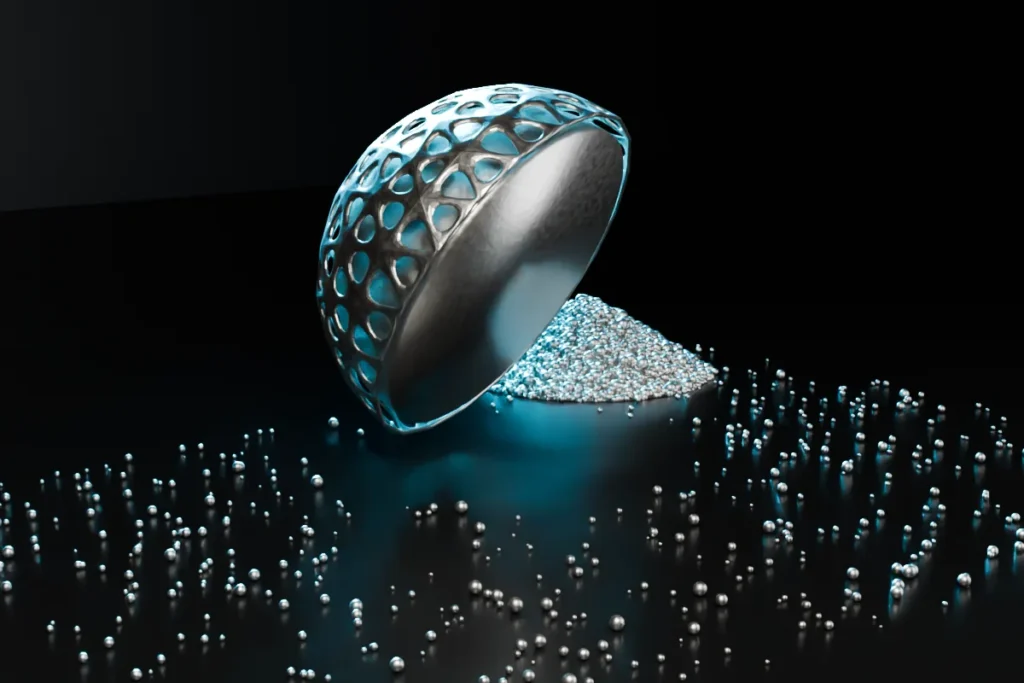
Metal 3D printing makes it possible to produce patient-specific geometries and complex implant designs. Titanium alloys are important candidates in this field. However, not every powder labelled Ti6Al4V represents the same material class, production history or scope of medical use.
Why are Grade 5 and ELI not the same?
Ti6Al4V ELI is an alloy grade defined by low interstitial element limits; it is also widely known as Grade 23. Although it belongs to the same base alloy family as Grade 5, it must be clearly distinguished in the purchasing specification. Carpenter Additive’s explanation shows this chemical class difference. Ti64 and ELI material description.
Instead of asking only for “titanium powder” in the quote, define the alloy, target standard, particle size, batch analyses and production method. ELI conformity should be documented by comparing the chemical composition with the relevant limits; a statement of “lower oxygen” alone is not sufficient.
Example uses of the material
- Patient-specific cranial and maxillofacial implants: anatomical shape, fixation points and manufacturability are addressed in the same design review.
- Orthopaedic implant development: load bearing, fatigue, surface properties and the post-processing plan are evaluated together.
- Porous or lattice implant regions: the manufacturability, cleanability and mechanical behaviour of the geometry are validated; adding a lattice does not by itself mean a better clinical outcome.
Information on personalised implants published by Materialise shows real fields of use such as craniomaxillofacial reconstruction. These are examples from specific manufacturers and products; the design possibilities described here are not a PRODA METAL implant or a claim of clinical success. Materialise personalised implant examples.
Consider powder suitability and part suitability together
ASTM F3001 is a specification for Ti6Al4V ELI components produced by powder bed fusion. Its scope is wider than checking the name of the raw powder. The purchasing file should make clear how the properties required for the part relate to the powder acceptance criteria.
Build orientation, supports, heat treatment, hot isostatic pressing (HIP) where needed, surface treatment and cleaning steps can affect the results. It should not be assumed that HIP is mandatory for every application or that a single heat treatment covers all designs. The validation plan must be derived from the responsible manufacturer’s design and quality requirements.
Example: the first material batch for an implant R&D team
For the first order, define the intended use of the target device and the required chemical grade. Record the supply and production batch of the powder; produce characterisation specimens and mechanical test coupons according to a representative plan. Review powder removal and surface accessibility in thin or enclosed regions at the design stage. Manage material and process changes in later batches through the same record system.
ISO 10993-1:2025 addresses the evaluation of biological safety within intended use and risk management. The raw material composition does not replace the biological evaluation of the cleaned and post-processed final device.
See the titanium alloy product page. State your ELI/Grade 23 requirement separately and submit a quote request. Availability, technical scope and product documents are confirmed per request.